Workplace Training Beyond the Workshop: Support Skills Where Work Happens
Workplace training beyond the workshop helps learners apply skills with timely job aids, manager support, and follow-up shaped around real work conditions.
The common mistake in workplace training beyond the workshop is assuming that a clear lesson automatically fits the conditions employees face on the job. When a process changes mid-task, a manager is unavailable, or a reference is hard to find, learners can be left guessing—and the organization may have to correct avoidable errors or repeat instruction.
A workshop can establish shared understanding, but transfer—the use of learning in actual work—depends on what happens around it. The design question is not simply what learners should remember; it is what information, permission, time, and help they can access at the moment they need to act.
Why do work conditions shape transfer?
In a training room, examples are selected and distractions are limited. On the job, people may face interruptions, incomplete information, competing priorities, or tools that differ from the ones used in practice. These conditions can block a skill even when a learner understands the lesson.
Before planning materials, identify the conditions that support or obstruct the target task. Ask employees and supervisors where the task occurs, what information is available there, who can authorize a decision, and what commonly interrupts the work. The answers may point to a resource or process change rather than another lesson.
Transfer support is the practical help that makes an intended action possible at work. It might be a searchable procedure, access to a supervisor for unusual cases, or protected time to practice. A useful support removes a specific obstacle; it does not merely repeat the workshop content.
What needs to be in place before learners try the skill?
Check whether learners have the opportunity and authority to use what they learned. If a new procedure requires approval that employees cannot obtain during a shift, a reminder card will not solve the delay. The approval path needs attention first.
Also check whether managers know what support is expected of them. A short briefing can explain when to invite a practice attempt, what questions to ask, and which decisions remain outside the learner’s authority. This gives managers a defined role without asking them to reteach the session.
- Task opportunity: Check whether learners will encounter the task in their normal work. If they will, arrange a supported attempt; if they will not, schedule a realistic practice situation instead.
- Decision authority: Check who can approve exceptions. If learners have authority within stated limits, make those limits visible; if approval belongs elsewhere, name the contact and escalation route.
- Resource access: Check whether the needed guide is available where the work occurs. If it is easy to reach, point learners to it; if it is buried or unavailable, provide an accessible version or fix access.
- Tool readiness: Check whether learners can use the required system or equipment. If access is ready, include it in practice; if not, arrange access or use a practice environment before expecting work application.
- Time and workload: Check whether a first attempt can happen without unsafe rushing or neglected duties. If time is available, agree on a suitable task; if not, coordinate with a supervisor to create a workable opportunity.
- Manager support: Check whether the manager understands the desired coaching role. If expectations are clear, share the prompt or observation guide; if they are not, brief the manager before learners begin.
- Exception handling: Check what learners should do when a case falls outside the procedure. If a clear route exists, include it in the job aid; if it does not, ask the process owner to define one before launch.
These checks help distinguish a learning gap from a workplace constraint. Fix the constraint that prevents a fair attempt before judging whether the learner can use the skill.
How should job aids support decisions at the point of work?
A job aid is a concise reference that helps someone complete a task or make a decision. It works best when it is built around the choices a learner must make, rather than organized as a miniature version of the training presentation.
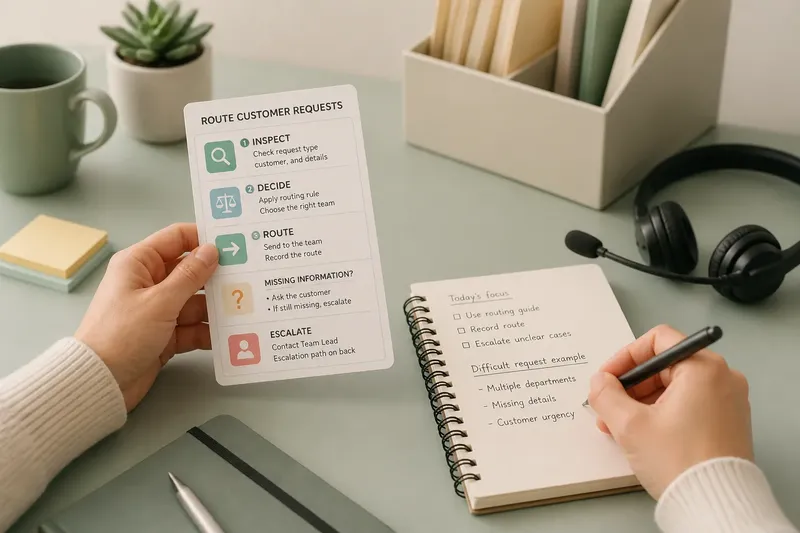
For a routing procedure, for instance, a useful aid might show the information to inspect, the rule for choosing a route, and what to do when the information is missing. Use familiar terms from the workplace and make the escalation path easy to spot. If a rule has exceptions, distinguish them from the ordinary case instead of hiding them in dense explanatory text.
Choose a format that suits the setting. A printed card may be practical near a work station; a searchable page may suit a task completed in a computer system. Ask a few intended users to locate a decision or instruction, then revise the resource if they cannot find it quickly enough for the task.
How can a work-based support plan fit a real schedule?
The following schedule is an invented illustration, not a recommended template. Its timing is only one possible arrangement; choose intervals based on when the task occurs, how much support it requires, and how the work is staffed.
Imagine a service team learning to route customer requests that sometimes involve more than one department. The starting conditions are a new routing guide, employees who have not used its decision rules, and a team lead available to answer questions during ordinary work. The design goal is to make the guide usable and give the team a safe way to surface ambiguous cases.
- Before the session: The facilitator shares the routing guide and asks each learner to bring one type of request that has been difficult to classify. The observable result is a set of questions about actual decision points; if learners cannot identify a relevant request, the facilitator uses a supplied scenario instead.
- During the session: The facilitator models how to apply the guide and lets learners practice with sample requests, including one with missing information. If learners can explain the route and identify the gap, the session moves on; if not, the unclear rule is discussed before work use.
- At the next suitable work opportunity: A learner uses the guide on an ordinary request while the team lead remains available. If the request fits a stated rule, the learner records the route; if it falls outside the guide, the learner pauses and uses the named escalation path.
- After an unclear case: The learner and team lead review which information was present and which rule was hard to interpret. If the guide resolves the issue, they note the decision for future reference; if it does not, they send the unresolved question to the process owner rather than improvising a new rule.
- At a later check-in: The team reviews recurring questions and decides whether to clarify the guide, adjust the process, or provide additional practice. If the difficulty comes from wording, revise the aid; if it comes from missing authority or information, address that work condition instead.
In this invented situation, suppose a request names two departments but omits the detail the guide uses to distinguish their responsibilities. The learner checks the guide, sees that the deciding detail is absent, and follows its escalation instruction rather than selecting a route by guesswork. The resulting answer is not a forced classification; it is a documented unresolved case for the process owner, with the guide’s unclear point identified for review.
What should follow a learner’s first attempt?
Follow-up should help identify the condition that shaped the attempt. A manager or peer can ask what information was available, which part of the aid helped, and where the learner had to stop. These questions reveal whether the next action is more practice, a clearer reference, or a change to the work process.
Keep the discussion focused on support and decisions, not surveillance. Tell learners what will be observed and why, especially when a task involves judgment or sensitive information. If the observation could affect formal performance decisions, follow the organization’s established process and explain it clearly.
When a task happens rarely, a brief reminder or scenario can help keep the decision path familiar until a suitable work opportunity arises. When a task is routine, a manager’s short check-in may be enough. Match the follow-up to the actual gap rather than scheduling repeated sessions by default.
Which questions help resolve transfer-support problems?
What if a learner knows the procedure but cannot use it?
Check access to tools, decision authority, workload, and the information available at the point of use. If one of those conditions blocks the task, address that barrier before assigning more instruction.
Should a job aid include every detail from the workshop?
No. It should help with the decisions or actions that arise during work, while background explanation can remain in a fuller resource. If users need context to interpret a rule, link or refer to that explanation without crowding the quick reference.
What if managers interpret the support role differently?
Give managers a shared description of what to do, what not to decide, and where to refer exceptions. If the role still conflicts with local responsibilities, clarify the process with the appropriate supervisor or process owner.
How can a team tell whether the resource is usable?
Ask a learner to find a specific instruction or decision rule using the resource in the setting where the task occurs. If the learner finds and applies it, keep the format under review; if not, revise its organization, wording, or access route.
How can teams separate a learning gap from a work barrier?
Start with the point where the attempt stalled. If the learner could not explain the decision rule, more guided practice may help. If the learner understood the rule but lacked information, permission, system access, or time, training alone is unlikely to fix the problem.
For example, if several employees stop at the same missing field, the pattern may point to a form or process issue. If employees have the needed information but choose different routes, compare their understanding of the rule and revise practice or guidance where it is unclear.
Workplace training beyond the workshop is most useful when each support is tied to a condition at work: access to a tool, a clear decision boundary, time for an attempt, or a reliable route for help. Before adding another lesson, ask what must be true for the learner to act—and make that condition visible in the plan.